Interactive spatial omics visualization and analysis in a single code-free desktop application. Explore tissues, run analyses, and discover biology — all without writing a line of code.
Features
MilliMap turns analysis results into interactive spatial objects. Click a gene in a DEG table to recolor the tissue. Select cells in UMAP and see them highlighted on the slide. No context switching.
Linked spatial and embedding views. Select cells in one, instantly see them highlighted in the other.
Preprocessing, clustering, DE, spatial stats, enrichment, batch correction — every parameter adjustable without writing code.
Every result becomes an interactive object. Click a gene or cluster pair and the tissue updates in real time.
Lasso, rectangle, or 3D volume selection. Save any region as a named ROI and pass it straight into downstream analysis.
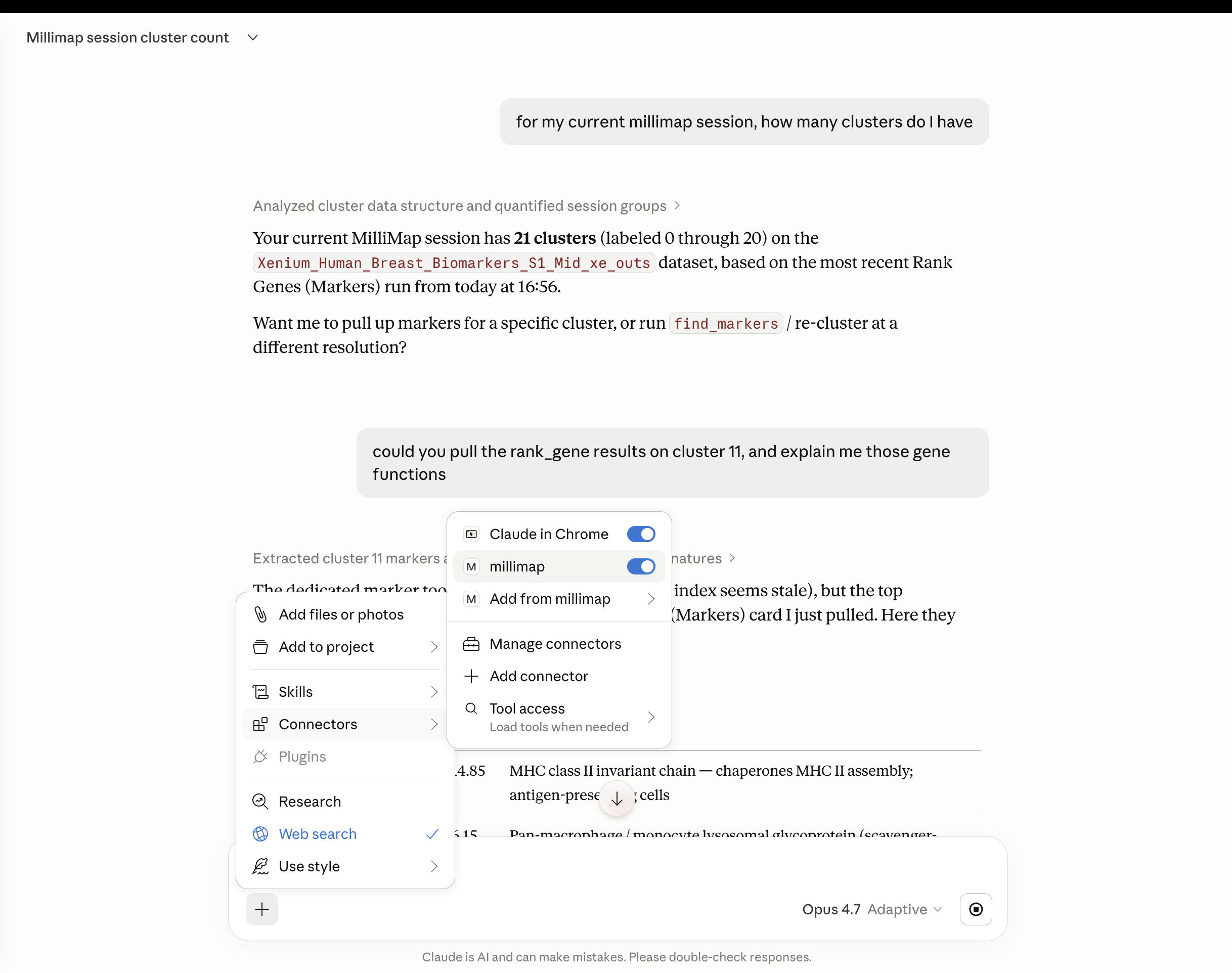
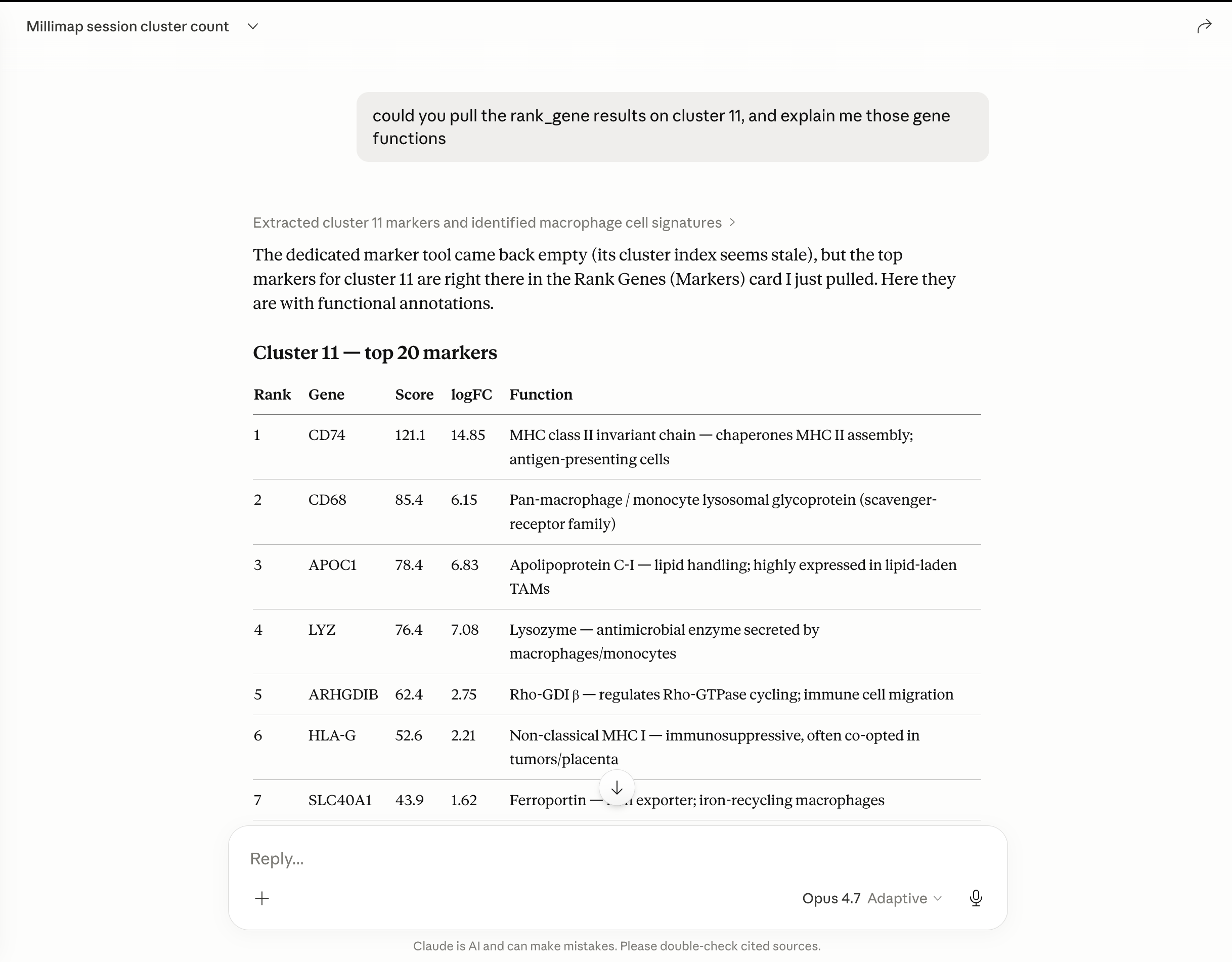
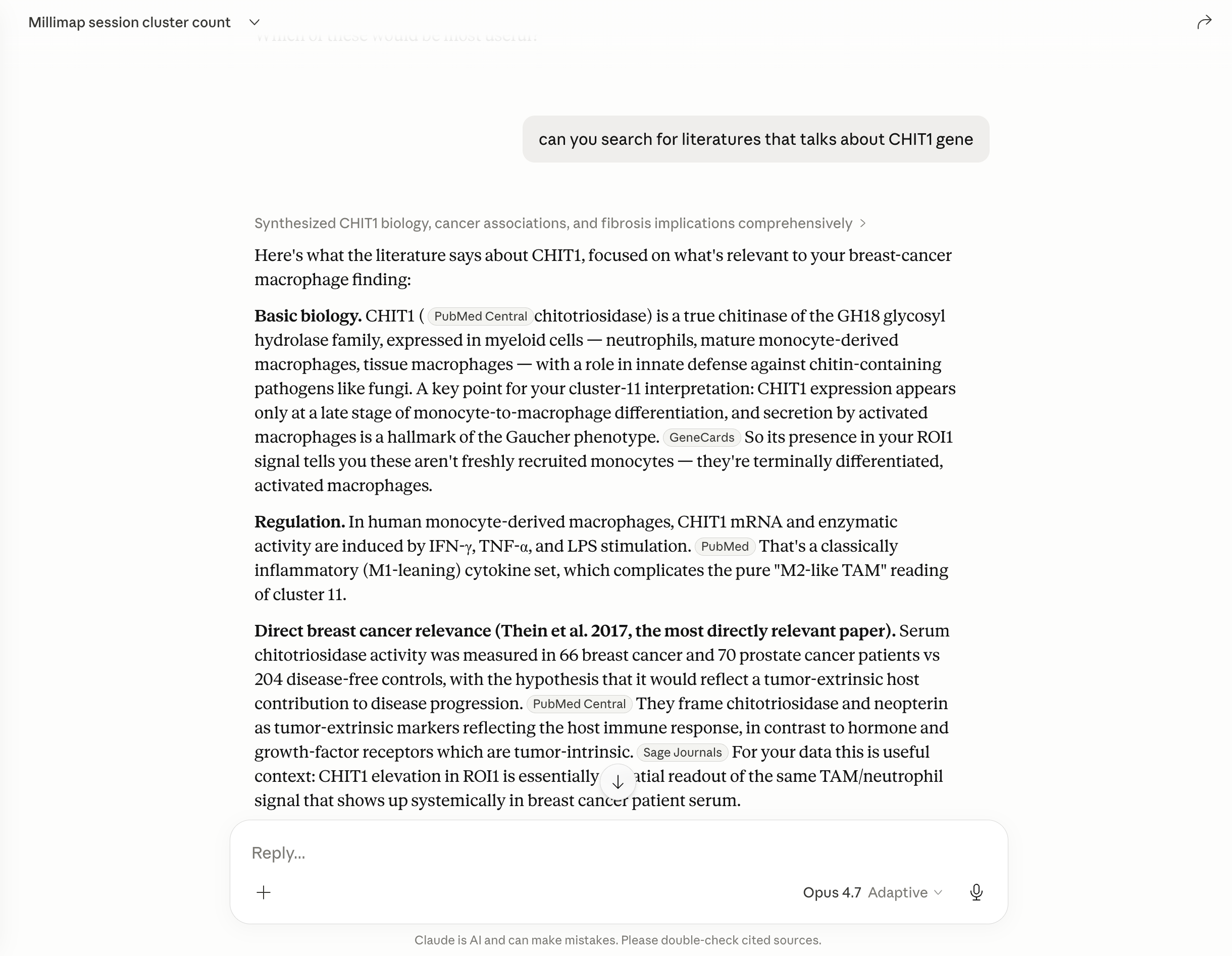
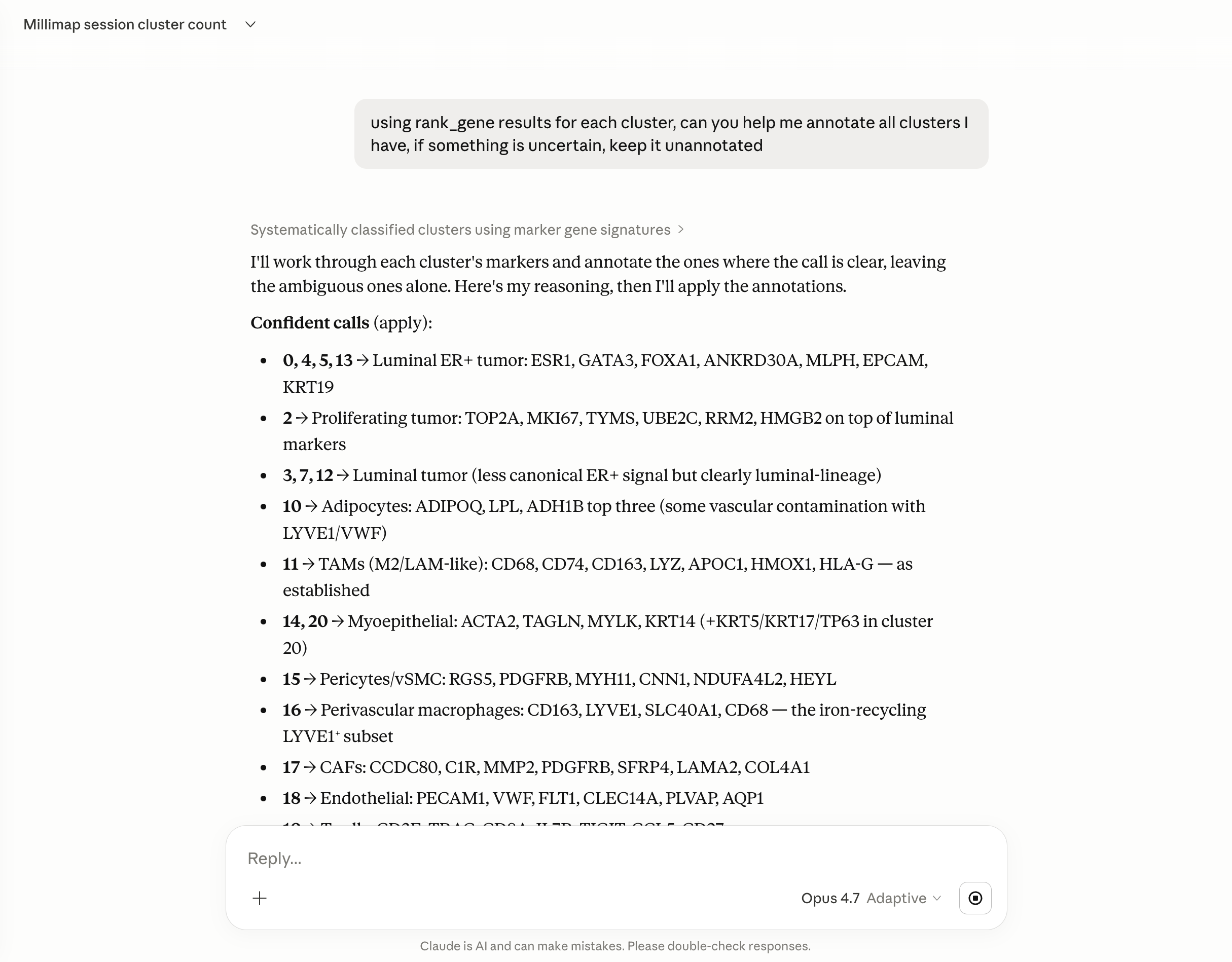
An LLM agent that turns natural-language questions into multi-step analysis, grounded in your live session state.
Export your session as a runnable Jupyter notebook, or save an archive to reopen the full workspace anywhere.
Get Started
Download the standalone app for macOS or Windows — no Python environment required. Or install from source with pip or conda.
Ecosystem
MilliMap integrates the best tools in the spatial omics ecosystem, connected through a unified GUI.
Preprocessing, clustering, and differential expression for single-cell genomics workflows.
Moran's I, neighborhood enrichment, and co-occurrence — the spatial side of the scverse ecosystem.
The standard annotated data container that powers the entire scverse single-cell ecosystem.
Hardware-accelerated 3D visualization for interactive point clouds and volumetric tissue rendering.
Gene set enrichment analysis with built-in support for MSigDB and custom gene libraries.
Fast batch correction for multi-sample integration across donors, conditions, and platforms.
How to Cite
If MilliMap is useful in your research, please cite our paper.
Feng, Q., Qian, S.B., Wan, L.J., Starr, Z., Asif, S., Han, H.-S. MilliMap: interactive spatial omics visualization and analysis. Manuscript in preparation (2026).